
An Interview with His Excellency Lawrence Meredith, EU Ambassador to New Zealand
Published 22 May 2026. Interview by Nury Choi and Zinzan Goertzen.
The views expressed in this piece are not representative of SPPANZ or taken to be those of SPPANZ. They are the author's own. SPPANZ is nonpartisan.
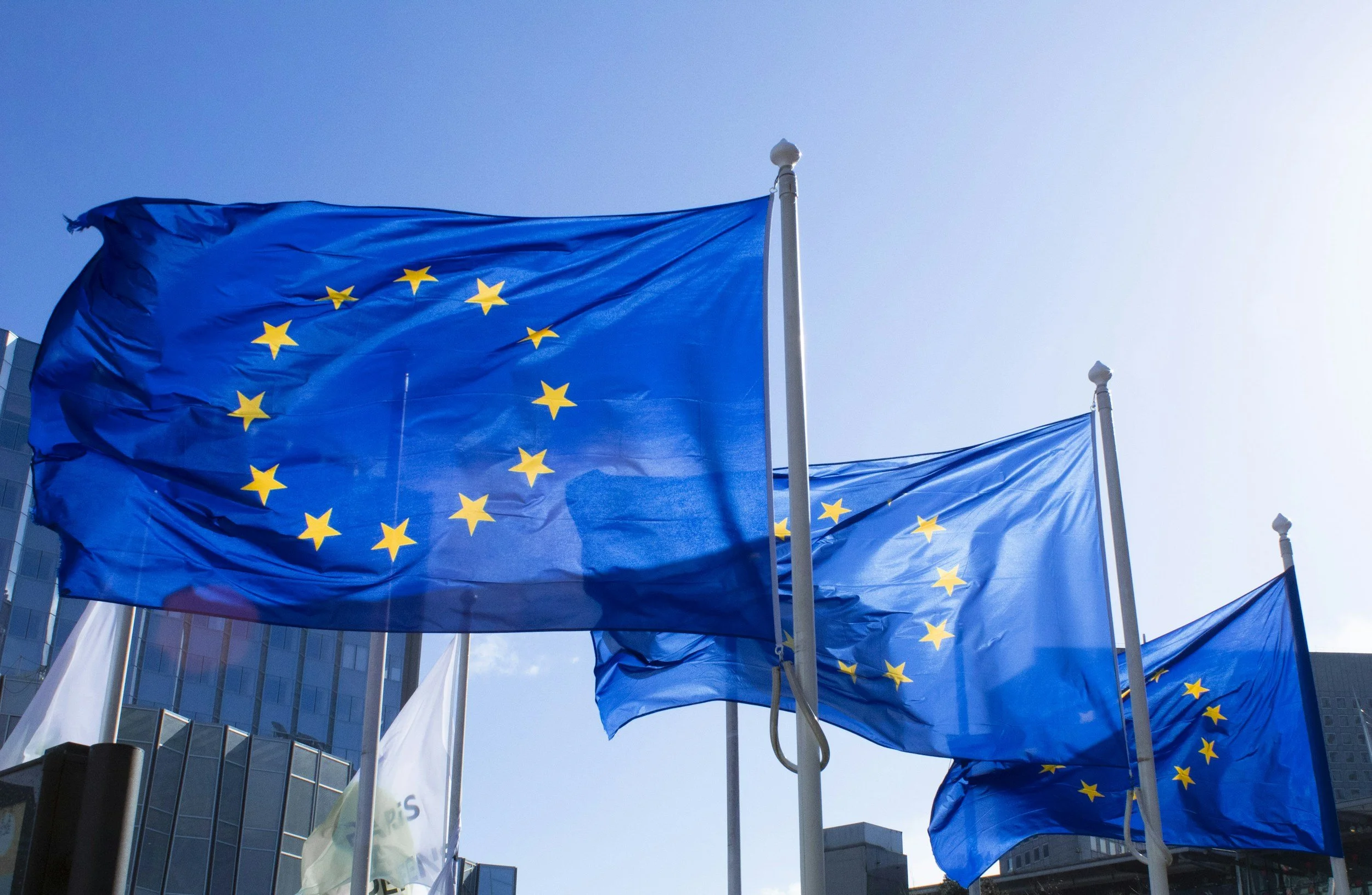
This interview was conducted on 24 March 2026, shortly following the conclusion of the EU–Australia Free Trade Agreement and Security and Defence Partnership.
Zinzan:
Hi Lawrence. How are you?
Lawrence:
Very, very good. Apologies to you and all online for the delay — not my normal habit. Normally I'm safely protected from any interruptions from headquarters, but the President of the European Commission is currently in Australia and is about to have a call with Prime Minister Luxon. So, it just meant I had to scramble something at rather short notice.
Forgive me if I'm a little bit discombobulated. I will do my best. Why don't you hit it? I will try and find my normal poise and rhythm, and I think it will flow. If the phone does ring, I will have to step out briefly. It was not the president herself, but somebody extremely close to her. So let's go for it, and thank you all for your patience.
Zinzan:
No worries, that's all good. I'll just introduce Nury first. She's the President of the Waikato Political Science Students Association.
Nury:
So lovely to meet you.
A Day in the Life of a Diplomat
Nury:
The first question is: could you run us through what a typical day looks like as a diplomat?
Lawrence:
That's an excellent and very timely question. I think, to quote Monty Python, you should always “expect the unexpected.” So in principle, no two days are ever the same. That might not be exactly the answer you're looking for, but I would say my day typically has somewhere between six and twelve meetings per day. Here in New Zealand, I would cover a range of subjects. I would say the most frequent theme I'm handling is trade.
Today, for example, I have a big focus on science, research, and innovation — Horizon Europe. We're going to bring together a number of the Deputy Vice-Chancellors of the eight universities, having a big reception. We've got one of our colleagues over from Australia to help us. But you never focus on any one theme all day. So, even if I'm about to plunge into three hours of science, research, and innovation, I'm delighted to engage with you. Public diplomacy, especially with young people, is something I think is particularly important.
As you gathered, you do have to expect the unexpected. It's less common when you're twelve hours ahead and 20,000 kilometres away, but you have to be very attentive to your top leadership, who can suddenly need a briefing. In this case, with the crisis going on in the Middle East, Prime Minister [Christopher] Luxon is understandably reaching out to like-minded partners, and there's a conversation going to take place in exactly two hours between Prime Minister Luxon and [European Commission] President [Ursula] von der Leyen. So, they call for the ambassador to give a briefing. That's a real life example. I don't think I can give you a fairer assessment than that.
Of course, added to that, to make it slightly more exciting, President von der Leyen has just — and I mean just, like one hour ago — put out a press release announcing that there's a free trade deal with Australia. There's a security and defence partnership, and they've launched negotiations with Horizon Europe. So that means you have to be mega attentive to real world developments.
Plus, at twelve o'clock New Zealand time, Nicola Willis [Minister of Finance] announced a fuel crisis package. So my briefing, which was due at 3pm New Zealand time, 1pm Australia time, has to include both Nicola Willis's package, which is precisely three hours old, and President von der Leyen's deal with [Australian Prime Minister Anthony] Albanese, which is exactly one hour old. So as I was writing, I was following the wires. Of course, she knows what she's just concluded with Albanese, but still, it's my obligation to set it out clearly and concisely.
Nury:
Do you think it's possible to maintain a good work-life balance in such a demanding role?
Lawrence:
Well, I'm not sure today is the best example. You should ask my wife and children. I think you need a supportive family. My family have always known me to be a highly engaged EU official, but you also need to make sure you respect the important moments for your family.
I give you an example of the latter. Last night, my second son got an award from the French Ambassador for the highest results in French in Wellington. So I went to the embassy, and I was glad to be the supporting role and see my son take the plaudits with the French Ambassador — even though I was the one drinking the champagne. He's just too young.
I think one thing that's nice about a diplomat's life, in contrast to, let's say, working at headquarters, is you can do quite a lot as a couple. New Zealand's diplomatic community is very inclusive. We're invited to bring our spouses to Waitangi Day celebrations, and that's a really powerful example of how we both got the opportunity to discover New Zealand and its inclusive approach. The outreach, the strong Māori tradition. So I think there are some advantages to diplomatic life, where you can collectively participate in a way that probably wasn't true if you were just in headquarters.
But you have to set your limits. I think if I had a message to young people: everybody's different. For example, we are twelve hours' difference, and I personally do my absolute best not to take calls in the evening. I try to concentrate on my work. I will work overnight by a mixture of WhatsApp and email. We have a working day in New Zealand, say 9:00 a.m. till 6:00 p.m., broadly speaking. Of course, being a diplomat, I may also have receptions in the evening.
The War in Ukraine and EU Security
Zinzan:
Thank you for that. Jumping into the next topic, which is a bit more of a hardball. The four-year anniversary of the full-scale invasion of Ukraine recently passed last February, and given you've just recently discussed the EU security deal with Australia — how has this war reshaped the EU's approach to security and its long-term international partnerships, such as those with New Zealand?
Lawrence:
That's an excellent question. I'm a specialist in Ukraine and Eastern Europe. I'm fluent in Russian. I work extremely closely with the Ukrainian Ambassador to Australia and New Zealand. I am passionate about standing for Ukraine against Russia's illegal and brutal invasion. I lead what we call Team Europe. I'm very active, and the Prime Minister is personally engaged in the Coalition of the Willing — something I, by the way, put in my recent briefing to President von der Leyen.
I think this has fundamentally changed the world we're in. To quote Prime Minister Mark Carney of Canada, “this is a new reality.” If there is a sort of silver lining, I think it shows that the world is totally globalised and that we need to really stand with those who have the closest and most shared values.
That's exactly what I've just underlined in the upcoming conversation between President von der Leyen and Prime Minister Luxon. We may be half a world apart literally, but we couldn't be closer on values, and we hugely appreciate New Zealand's support for Ukraine. It's existential, because it's utterly unacceptable for any sovereign state to invade another, and that sets an intolerable precedent. New Zealand and the European Union both stand for the rules-based international order, and it's imperative that we do everything possible to support Ukraine to victory.
Zinzan:
How do you find the EU is keeping that momentum with its international partners four years later? Has it been difficult to keep momentum?
Lawrence:
It's existential for Ukraine, but it's also existential for the European Union. Ukraine is part of Europe. They have a path towards membership of the European Union. In that context, we in the European Union are doing everything possible to rally global support. We were quite encouraged by the recent votes in the UN, which show increasing numbers of countries coming around to Ukraine — in this case, the resolution on Ukraine.
Of course, the military situation is very challenging, but the other thing I would say is Russia is losing this war. Their economy is crumbling. They're morally in the wrong. I think we have to make that crystal clear.
Increasing numbers of countries have understood that it's really important that Ukraine prevails, because what Ukraine is doing is defending its own sovereign territory and its own people. It's tragic, the loss of life, but I have immense admiration for President Zelensky, maintaining a functioning government despite four years of war.
I can tell you the European Union, together with New Zealand, Australia, Canada, Japan, South Korea, the UK — I mean, I could go on — we're doing everything possible to maintain that coalition of the willing. I think it shows the creativity in international relations: when there's a blockage, unfortunately due to the invasion by one of the members of the UN Security Council of another sovereign state, we have to look at alternative mechanisms while maintaining our commitment to the UN long term to find support for Ukraine.
The EU–New Zealand Free Trade Agreement
Nury:
Jumping on to trade now — what impact has the EU–New Zealand Free Trade Agreement had so far?
Lawrence:
Massive. I think for both sides. It's been in force for almost two years. It will be on the first of May 2026 — it came into force first of May 2024, as I'm sure you know. That's seen over $2 billion in additional exports for New Zealand exporters, mainly in horticulture. Kiwifruit, onions, pears, apples, wine, seafood.
[Editor's note: By the Agreement's second anniversary on 1 May 2026, Kiwi exports to the EU had grown by $3 billion over two years, reaching $8.8 billion in the year to December 2025 — up 29 per cent. Source: NZ Government, 1 May 2026.]
We also had the first ever European Union–New Zealand Business Summit, which we organised with Prime Minister Luxon and Trade Commissioner Maroš Šefčovič in Auckland in October. Five hundred people, six ministers, a visiting Commissioner, twenty-six of the twenty-seven member states present, five hundred business leaders.
We had five topics of conversation. We talked about agriculture, infrastructure, aerospace, defence, deep tech, AI, clean tech, and renewable energy. We also discussed how to make a reality of the Māori chapter [of the FTA], and how Horizon Europe and the innovation partnerships between the European Union and New Zealand could be transformative for both our economies.
Nury:
What makes New Zealand a good partner for the European Union, and vice versa?
Lawrence:
I really have to stress it's this shared values point. When I first came to New Zealand over two years ago, that seemed so much motherhood and apple pie. But in the increasing global crisis — Russia's war in Ukraine, the current crisis in the Middle East, the shooting oil price — you can see from the fact that the reason we had to slightly delay this call is there is contact between the very highest levels, Prime Minister Luxon and President von der Leyen, to discuss how to address this. That's only possible if we have a shared vision of the world's global challenges and we're working together to find solutions.
I will give you another example. In November, Šefčovič, the Trade Commissioner, visited Australia shortly after his visit to New Zealand to launch the European Union's dialogue with the CPTPP — the Comprehensive and Progressive Trans-Pacific Partnership — which brings together twelve countries, including New Zealand. Together, the CPTPP countries and the European Union — so thirty-nine countries — represent over a third of world trade and over a third of world GDP. So we can assert our belief in the rules-based international order by working together and sticking to those rules, even if others clearly take different views.
Opportunities for Young People
Zinzan:
Jumping to our final topic — what opportunities does the EU have for young people like Nury and myself, and what can we do from New Zealand to jump across and see what's over there?
Lawrence:
That's an excellent question. Firstly, I'm passionate about youth diplomacy, and I'm committed to doing everything possible to enhance youth exchange between the European Union and New Zealand. I wish they were on a larger scale.
There are some small-scale programmes of scholarship, the most obvious of which is Erasmus Mundus. We only send about five to ten students per year. I wish it were more, but it's a global scheme. I have just given the awards to a number of Erasmus Mundus scholars this year. That allows you to do a year overseas in the European Union.
Of course, you can take advantage of different working holiday opportunities. I know many young European Union citizens come to New Zealand, and they're passionate about the working holiday scheme here. I also think that if you're a young academic, Horizon Europe offers great possibilities. I would encourage you — the OE [overseas experience] is a big deal for Kiwis, and I'm actually really impressed at how much young Kiwis know about the European Union. It is encouraging, and I think it is fundamental.
I would put the question to you: if you have other creative ideas of how to engage, I'm trying to set up an alumni association. I was just discussing that this morning — for the Erasmus Mundus scholars from New Zealand to the European Union, to harvest the intellectual capital and the common commitment to EU–New Zealand relations that that represents.
Of course, I commend you young people, and I'm particularly delighted to see the NZIIA [New Zealand Institute of International Affairs] Youth Forum engaging with the European Union and other formats that you know better than me [SPPANZ]. I will always do my best, and also encourage my fellow EU ambassadors, to engage with young people. Always open to suggestions — so if you have ideas, please put them to me now or in writing.
Ambassador Meredith encouraged students to reach out directly with ideas for EU–New Zealand youth engagement.